

Chicken Feed And French Fries: Patterns In When And How Advertising Shifts Culture
If change doesn’t happen in a vacuum, neither does advertising.
Cultural shifts and effective marketing are a package deal—one influences the other, and vice versa. To uncover how ad campaigns and watershed moments in history influence public perception, Prager Creative investigated how both unraveled over the past 100 years.
From financial crises to space races to tech revolutions, how advertising influenced the perception of these events strongly hinges on what’s at stake. With this exploration of the past, we discovered uncanny truths about American culture, and the most effective ways businesses can tailor their voice for whatever challenge comes next.
Economic Changes: When Times Get Tough, The Tough Get Advertising
It doesn’t take a PhD in Economics to know that consumers buy less during recessions, ultimately changing how businesses prioritize advertising. But, what about when things get really bad, like “reports of stock brokers jumping out of the Empire State Building” bad? Or the “entire world is at war” bad? When there is a massive, stressful shift the economy, the best advertising takes an altruistic, earnest approach to connecting with consumers.
When recessions hit, priorities change. America has seen several economic slumps over the past century, but one stands out against the rest: The Great Depression. The reports of stock brokers leaping to their deaths is a 90-year-old myth America still can’t shake. Those stories illustrate the levels of terror associated with the early 1930s. Braving massive unemployment rates and homelessness—not to mention the Dust Bowl—Americans switched from trying to have it all to scrambling to get what’s needed. Advertising groups had to adapt alongside this change in national priorities.
And that’s when something exciting happens: recessions force advertisers to throw out their playbook to survive. When it’s sink or swim, only the best and boldest can make their way through to an economic recovery.
During the Great Depression, companies were forced to think outside the box, to find new ways to connect with audiences. The most successful approaches focused on restoring dignity to people who needed it most. When some grain and animal feed companies discovered that farm families needed to use cotton sacks to make clothing, these groups decided to print cheery, floral patterns on their bags.
From an empathetic perspective, this move restored a sense of dignity to parents and children suffering from poverty. Going to school with a dress that says “U.S. Chicken Feed Conglomerate” printed on the side could easily reinforce a sense of shame for struggling kids. These printed fabrics gave feed companies an advantage over the competition. Who wouldn’t want to dress their toddler in a happy floral jumper? With the choice between buying from a feed company that gives you that fabric for free or one that doesn’t, the decision is simple.
 An advertisement showcasing how to repurpose one company’s printed feed sacks. Image Source: Slate
This human-first approach to marketing during The Great Depression proved quite successful—so successful, in fact, that many companies continued to use printed fabric for their feed bags decades after the economy recovered. This history largely remained untold for decades, since the process of repurposing sacks unfairly carried a socioeconomic stigma. As the definition of what’s considered “fashion” has become more inclusive, the narrative associated with farmers’ families making their own clothes shifted from a hidden secret into a celebrated example of American innovation. Today, designers and hobbyists consider 1930s feed sacks highly collectible and even share tips on how to identify counterfeits.
Soon after the Great Depression, another massive economic influence in America emerged: World War II. With ration cards being issued by the government for everything from nylon stockings to butter, virtually every purchase was strictly regulated by the war effort. With fewer clients looking to advertise, agencies looked for a new outlet.
Ever wonder why America’s WWII posters are still considered iconic? They were made by advertisers.
The U.S. government and the Ad Council teamed up to create the War Advertising Council, also known as WAC. The advertising it developed definitely made an impact. The WAC subsidized advertising for companies willing to promote approved war messaging. It was an offer many businesses couldn’t refuse—the WAC covered 80% of the costs for these ads at a time when consumption was low. Because of this arrangement, most of the iconic imagery from WWII was developed by creative teams hired by private companies.
 Together We Can Do It: via GM; Rosie The Riveter: via Westinghouse Electric; Lose Lips Might Sink Ships: via Seagram’s. Image Source: National Archives
Although these particular examples from GM, Westinghouse Electric, and Seagram’s seen here had just a handful of prints circulated during WWII, they continue to remain relevant and are not forgotten because of their simple, iconic messaging and bold design. Unlike other ads from the same era that relied on discriminatory visuals, posters like Rosie The Riveter stood the test of time because they brought Americans together instead of dividing them apart.
Uncertain times mean uncertain consumers. If it’s hard to picture what the world will look like tomorrow, it’s comforting to see signs of solidarity from friends, strangers, and even print ads. Never underestimate the power of being the helping hand needed when crisis strikes.
Generational Ideals: When Normal Changes, Advertising Follows Suit
Cultural revolutions make a huge impact on how companies resonate with consumers. If people change, then the methods to reach them must follow suit. Whether it’s the Civil Rights Movement, the Women’s Liberation Movement, or recent protests calling for social justice, marketing teams who adapt quickly can help brands connect with audiences on a more meaningful level.
Within the past century, one of the greatest generational shifts in the way Americans dressed, interacted, and advertised started in the 1950s and lasted well into the 1970s. With marches, boycotts, and riots, the death rattle of America’s Jim Crow era started to rumble across the country. As a widespread push to fight for racial justice eventually resulted in passing the Civil Rights Act, brand campaigns shifted their approaches to race representation.
Before looking at how major corporations changed their portrayals of people of color in advertising, it’s crucial to recognize this isn’t a solved problem—prejudicial and racist portrayals of marginalized groups remain an insidious issue in American culture. There are many examples of tone deaf campaigns continuing to pop up in 2020. Authentic representation of all people is a necessary movement that needs to continue. But, to know where to go, it’s important to investigate where advertising started to depict marginalized groups as independent, autonomous consumers.
In the 1970s, marketing behemoths started to recognize the generational shifts pushing for equality on multiple fronts and wanted to make sure their products weren’t left in the dust. Black families were featured in campaigns for restaurants like McDonald’s for the first time.
 For context, it’s important to know that these ads were not only featuring Black consumers but also written and designed by a Black-owned ad agency, Burrell Communications. Image Source: The Atlantic
Taglines like, “On the real, kids can really dig gettin’ down with McDonald’s,” and, “Maurice and his lady are getting down with some cheeseburgers,” sounds odd from a contemporary perspective. But, McDonald’s decision to have a Black-owned agency develop and write these ads was a groundbreaking choice for stronger representation of non-white voices. What remains significant about these ads is how they depict black families and couples as active and capable decision makers—their presence is not meant to bring humor or folksiness to ads targeting white consumers. Ultimately, this targeted campaign yielded great success—it increased overall revenue and sales for the restaurant.
Coca Cola also achieved success when it adapted to the changing cultural landscape of the 1970s. Still considered one of the most iconic ads ever made, the “I’d Like To Buy The World A Coke” ad made a lasting impact on consumers.
Officially known as “Hilltop,” this advertisement, which came from a company that historically only featured white consumers in its ads for decades, was a massive success. By adapting its ads to changing cultural priorities, Coca Cola created something that still resonates with viewers today.
Additional cultural milestones like the Women’s Liberation Movement included its fair share of targeted marketing. Virginia Slims were debuted to the world in 1968 sporting the tagline “You’ve Come A Long Way Baby” to reach women looking for more autonomy in their lives. Phillip Morris’ decision to exclusively market to this emerging demographic seemed risky to other companies, but the campaign paid off. To this day, it’s one of the most recognizable slogans of the era.
Today, we’re seeing ads continue to adapt to social transformations. Nike’s 2018 ad showing a close-up of Colin Kaepernick has a similar motive of aligning brand messaging with shifting priorities. While it led to a small portion of consumers to protest, the ad actually increased overall support for the brand. Nike’s shoe collaboration with Kaepernick sold out on the first day of its release.
Considering all of the current social and political movements sparked after the killing of George Floyd, many public figures have gone on to publicly apologize to Kaepernick for criticizing his decision to take a knee during The National Anthem. Now, Nike’s ad supporting this activist and athlete is already considered ahead of its time just two years after it debuted.
Technology: New Breakthroughs Are Best Marketed With Wholesome Advertising
Whether it’s the dream of space travel or universal WiFi, getting buy-in from those outside of the tech world is key to turning these ideas into reality. For decades, selling the hope, not the danger, associated with tech advances was the job of marketing teams.
The space age aesthetic of the ‘50s and ‘60s might have seemed new to most people. When you look a little closer, though, there’s a common thread in the ads and media of that era.
Jet propulsion and its associated technologies were branded as an opportunity for exploration, for adventure akin to the wonder associated with the Wild West and the righteousness of Manifest Destiny.
 Space-related advertisements evoked the divine providence depicted in Manifest Destiny and the sense of adventure linked to exploring the Wild West. Image Source: Gizmodo
This familiar, yet exciting, imagery reminded Americans that their country traversed the unknown before—and they can do it again.
When American consumers exited the space age, so did advertisers. The tactic of promoting tech using relatable imagery, however, remained popular. As personal computers transformed into something wired for the average consumer, companies needed to find a way to make this expensive, newfangled thing appear necessary for daily life.
Within the context of promoting personal computers, advertisers used images of yesteryear to market these machines as simple and user-friendly. In one of the first print ads for the Apple II, it’s hard to tell if you’re is looking at a computer ad or a Leave It To Beaver spinoff:
 A print ad for the Apple II, which debuted in the late 1970s. Image Source: The Atlantic
Without the computer in the foreground, this commonplace domestic scene looks like it could be an advertisement for dish soap. The seamless insertion of computers into the American Dream turned tech into both an aspirational and a commonplace tool for consumers.
This trend doesn’t stop with Apple. For the better part of the 1980s, IBM relied on television commercials and print ads with a Chaplin-like character to promote their software. As a mascot with roots in the silent film era, he allowed the company to provide simple explanations of their specs alongside imagery that’s wholesome and familiar.
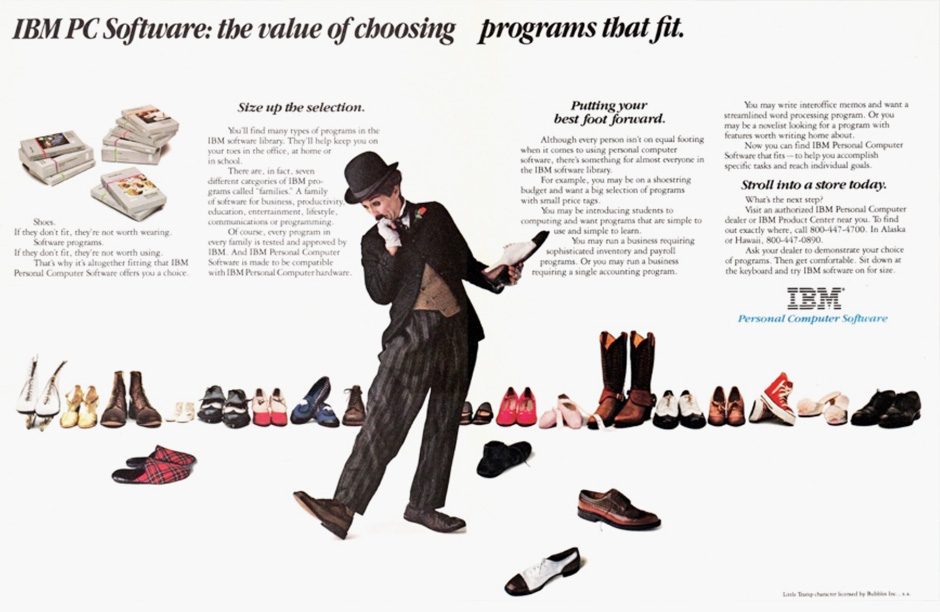 IBM’s Chaplin-like spokesman (even though he never technically “spoke” in the ads). Image Source: Personal Computer Museum of Canada
Once computers became more commonplace, futuristic ads like the famous 1984 Apple Super Bowl commercial started to pop up since companies no longer needed to market an unheard of product.
Besides the home computer, the iPhone is perhaps the most game-changing piece of consumer tech to appear on store shelves. So, how did Apple choose to introduce its invention to the world?
Using some familiar “hellos,” of course:
With 30 seconds of greetings from pop culture icons, Apple connected its product to decades of history. This fun, cheery ad didn’t involve price tags, reception capabilities, or anything of the sort—after all, those facts wouldn’t matter to an audience who has never seen a smartphone of this caliber before.
Rooting radically new tech in reality works by building trust with consumers in a non-threatening way. Whenever the next great leap in technology comes, you can count on advertising to make seem as down-to-earth as possible.
Dr. Ad Man: Advertising as America’s Healthcare Oracle
Since the first prescription drug commercial aired in 1984, pharmaceutical companies and the FDA battled over what was, and wasn’t, appropriate messaging in this type of direct-to-consumer advertising. In 1997, everything changed. The FDA relaxed these restrictions to allow pharma ads to refer consumers to print ads in magazines, 1-800 numbers, or websites for further details. In turn, this allowed ad execs and drug companies to develop the emotionally persuasive commercials seen today.
According to a study conducted by the Kaiser Family Foundation, these ads hold a powerful influence over consumers. For every person viewing a pharmaceutical ad, an estimated 18-30% of them will visit their doctor to discuss the drug. Expected benefits, side effects, and specs about medicines have significantly less dedicated airtime or print ad space compared to the curated depictions of carefree patients.
The effectiveness of advertising to change public perception of healthcare isn’t just a lucrative outlet for Big Pharma—advertising can also do some good, particularly if it’s surrounding a misunderstood and fatal illness.
Known as the photo that changed the face of AIDS, the picture seen below was originally published in black and white by Life in 1990. Two years later, the Art Director of United Colors of Benetton colorized this portrait and used it to shift public perception of a stigmatized, globally arresting disease.
 The famous, and controversial, United Colors of Benetton ad showing activist David Kirby dying from AIDS-related complications. Image Source: International Center of Photography
Catholics called it sacrilegious.
Magazines marked it unprintable.
Activists labeled it “tasteless.”
But, this backlash didn’t dampen the power of the image. It shined a light on what actually happens to people dying from AIDS complications. These weren’t immoral individuals who had it coming—they were people who needed care and support. Although some early HIV/AIDS organizations issued statements calling the ad exploitative, curiosity over the photo grew. As public interest in the image increased, the ad’s influence spread like wildfire.
Some researchers estimate over 1 billion people have seen this photograph at least once in their lives. This striking portrayal, somehow filled with both fear and love, intensity and quiet, forced viewers to stop and reflect on their role in this health crisis.
Years after the ad was printed, David Kirby’s mom, pictured in the photograph alongside the rest of her family, had the following to say about the ad’s legacy:
“Benetton didn’t use us, or exploit us. We used them. Because of them, [David’s] photo was seen all over the world, and that’s exactly what David wanted.”
Health is both a personal and universal challenge for all walks of life. We all worry about lumps and bumps, pains and aches. Healthcare ads and health-based activism resonates so deeply because they tap into each person’s vulnerability as a single, mortal individual.
Where Do We Go From Here?
There are many important overlaps between past advertising trends and what’s happening today:
• Massive economic changes and unemployment numbers, similar to the Great Depression
• Huge generational shifts in politics and how people communicate, similar to movements of the 60s and 70s
• A health crisis already being called a force that will change the world permanently, perhaps more so than the AIDS epidemic
Right now, there is an unprecedented opportunity to connect with audiences in a positive light. When else has every person across America, and most of the world, had the same thing on their mind? No matter their specific thoughts on reopening businesses, going back to school, or fear for their loved ones, the emotions are similar.
We are all waiting in anticipation. There is anxiety, tension, and none of us are certain of what’s going to happen next. Your brand can do something about it.
Companies are dealing with a massive, captive audience. It’s very similar to the reason why brands invest in Super Bowl advertising and why it works so well. For a short time, the realities of the real world are set aside.
Forward-thinking organizations have made a strong commitment to meaningful actions. From Anheuser-Busch repurposing their plants to manufacture free hand sanitizer, to Coke handing over their social channels to medical experts to provide reliable COVID information, plenty of groups have found ways to give genuine support instead of shilling out watered-down lip service. When it is genuine, corporate action in advertising yields two positive outcomes: a better financial outlook for the business itself and a sense of hope for those in desperate need of leadership.
If you want to stand out in this environment, think like a 1930’s chicken feed distributor: stay one step ahead of what consumers really need.
What are the gaps not being filled by federal and state resources? What are the thoughts keeping parents up at night? What keeps you up at night? Answers to questions like these are where your company can make a difference. Just keep in mind that you should stick to what your firm stands for at the end of the day. Pausing to make sure you’re providing something of substance to the conversation will help you resist the urge to react with shotgun advertising. Doing so is how you lose control of the conversation you should control. Embracing your brand’s history and mission will help you remain authentic and relevant no matter what is happening in the world around.
Read more of our thought leadership articles.
Check out some of our work.
Interested in how we can partner together on the next big trend in marketing? Let’s get in touch.


